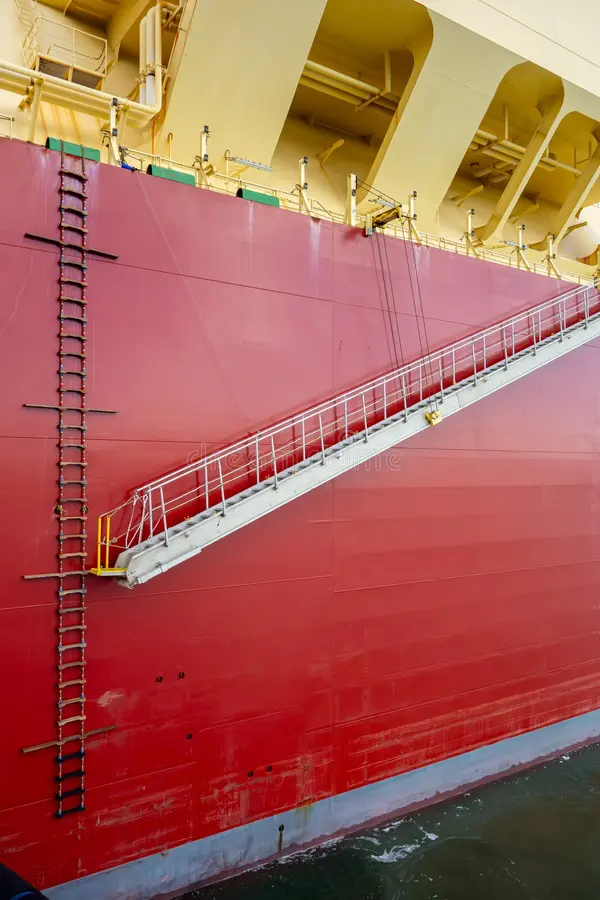
From 1 January 2028, pilot transfer arrangements move from IMO recommendation to mandatory SOLAS law — and the new rules apply to existing ships. Amended SOLAS regulation V/23 (Resolution MSC.572(110)) and the new Performance Standards in Resolution MSC.576(110) introduce type approval, quantified strength values of 48 kN and a fixed service life for every pilot ladder. For most operators the real deadline is 2027, because structural work must be completed at the last dry-dock before the ship is surveyed.
What is MSC.576(110)?
MSC.576(110) is the IMO resolution, adopted on 26 June 2025, that sets the mandatory Performance Standards for Pilot Transfer Arrangements referenced by the new SOLAS regulation V/23. It replaces the previous recommendations in Resolutions A.1045(27) and A.1108(29) and references ISO 799-1:2019 and ISO 799-3:2022.
It is organised in six parts:
- Part A – design, manufacture and securing of pilot ladders
- Part B – rigging, combination arrangements and side openings
- Part C – pilot ladder winch reels
- Part D – operational readiness, inspection, maintenance, service life and spares
- Part E – familiarisation of onboard personnel
- Part F – approval of arrangements and type approval of equipment
The Regulatory Reality: Who Must Comply, and When
| Requirement | New installations (on/after 1 Jan 2028) | Existing SOLAS ships |
| Parts D & E (inspection, service life, spares, familiarisation) | 1 Jan 2028 | 1 Jan 2028 |
| Parts A–C (design, securing, rigging, winch reels) | At installation | First annual, intermediate or renewal survey on or after 1 Jan 2029 |
| Part F (Administration approval) | Before first use | After any repair or alteration |
Non-SOLAS existing ships have until 1 January 2030. The IMO has also invited Administrations to apply the amendments voluntarily before 2028 (MSC.1/Circ.1690).
The practical point: from 1 January 2028, a ladder past its service life, a missing spare or a missing 3-monthly inspection record is a PSC deficiency on any ship — regardless of when the arrangement was installed.
Five Changes That Drive Cost and Lead Time
1. Pilot ladders get an expiry date
Every pilot ladder and set of manropes — spares included — must be withdrawn 36 months after manufacture or 30 months after being placed into service, whichever comes first (§30). Repairing or replacing steps is prohibited (§28). A ladder sitting in the store is already counting down.
2. Strong points become a calculated item
Strong points, shackles and securing ropes must have a breaking strength of at least 48 kN, be permanently marked and documented, and be located at least 915 mm from the deck edge (§6.1). On older bulk carriers, existing pad eyes are often unmarked, uncertified and too close to the edge.
3. New equipment on board
- A type-approved device to secure the ladder at intermediate length, gripping both side-rope pairs (§6.3)
- At least one spare compliant ladder and one spare set of manropes (§29)
- On combination arrangements: protection against inadvertent operation of the hoisting mechanism, and a white-over-red pilot boarding mark of at least 4 m × 0.5 m (§5.6)
4. Hard dimensions
- Handhold stanchions: Ø32–36 mm (§8)
- Side doors: minimum clear opening 2,200 × 915 mm (§7.1)
- Winch reel drum: ≥0.16 m diameter (§16)
- Ladder long enough to reach the water in the lightest seagoing condition with a 15° adverse list (§4.5)
5. Approval moves to the Administration
Ladders, manropes and intermediate securing devices must be type-approved (§36–37). Installed arrangements need Administration approval after any repair or alteration, and the Record of Equipment will be reissued.
Which Ships Are Most Exposed?
- Ships with a freeboard above 9 m in ballast (Capesize, Kamsarmax, Panamax, many Supramaxes) — combination arrangement, trapdoor rules and pilot mark apply
- Arrangements installed before July 2012
- Ships with pilot ladder winch reels or side-door boarding
- Older tonnage with unmarked, uncertified strong points
Step-by-Step: A Realistic Compliance Roadmap
- Assess (Q4 2026 – Q1 2027): inventory every ship — freeboards, boarding positions, winch reels, side doors — and run an onboard gap survey of every boarding position, both sides.
- Engineer and plan (Q1–Q2 2027): define modifications per ship, check strong points and local structure for 48 kN, and submit drawings to Class/Flag.
- Procure and modify (Q2–Q4 2027): order type-approved ladders, manropes and devices with just-in-time delivery; carry out structural work at the 2027 dry-dock.
- Systems and people (Q3–Q4 2027): revise the SMS pilot transfer procedure, add PMS jobs, introduce a service-life register and run crew familiarisation (STCW I/14).
- Operate and verify (2028 →): Parts D and E live on every ship; independent verification before the first survey in 2029.
Do These Today — No Cost
- Remove cable ties, U-clamps and hose clips from ladder steps
- Quarantine any ladder with repaired or replaced steps
- Record the date of manufacture and date into service of every ladder and manrope set
- Never secure the pilot ladder to the lower platform of the accommodation ladder
| The FleetPreserve Angle: The most expensive pilot-transfer finding is not a missing ladder — it is a strong point or trapdoor that needs hot work in a ballast tank after the dry-dock has already sailed. An independent gap survey in Q4 2026 tells you which ships need yard work, which need only procurement and SMS changes, and lets you put the structural items in the 2027 yard specification instead of paying for an afloat repair and the off-hire that comes with it. |
Conclusion
MSC.576(110) turns pilot transfer from a “good practice” item into a surveyed, dated and type-approved system. Owners who treat 2027 as the deadline will spread the cost across planned dry-docks; those who wait for the 2029 survey will pay for it in detentions, refused pilots and unplanned off-hire. FleetPreserve carries out fleet gap assessments, strong-point engineering and Class/Flag submissions, SMS packages and pre-survey verification for bulk carriers and general cargo ships. Contact us at info@fleetpreserve.com or visit fleetpreserve.com to plan your fleet’s 2028 compliance.
Download the full Technical Advisory FP-TA 01/2026 for the complete item-by-item comparison and the 46-point self-assessment checklist.