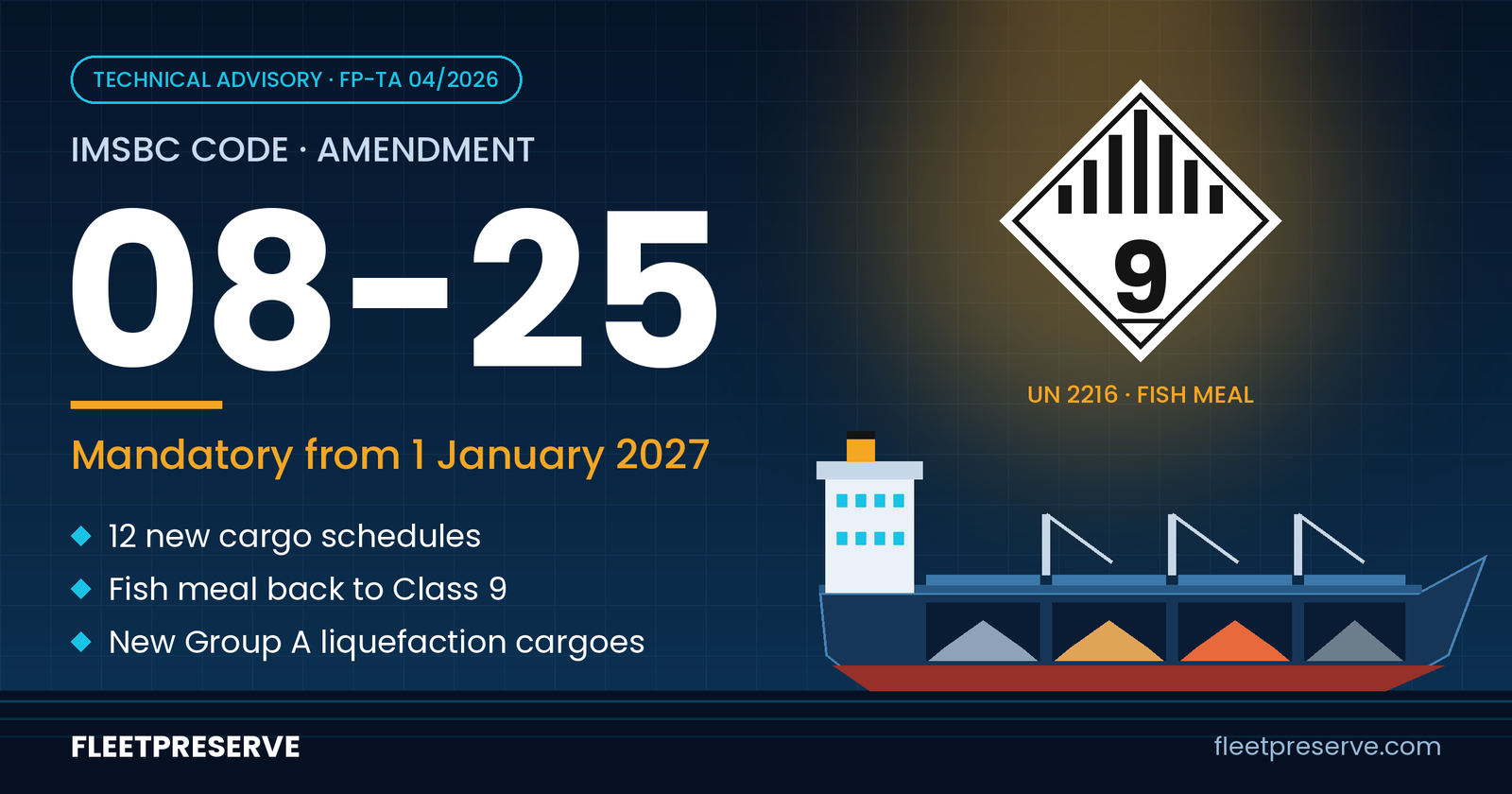
From 1 January 2027, Amendment 08-25 of the International Maritime Solid Bulk Cargoes (IMSBC) Code becomes mandatory under SOLAS chapters VI and VII (Resolution MSC.575(110)). It adds twelve new cargo schedules, amends eleven more, returns fish meal UN 2216 to Class 9 and revises the segregation table. Some changes alter what a ship is allowed to carry; others change how cargo must be accepted, monitored and entered.
What Is IMSBC Code Amendment 08-25?
Amendment 08-25 is the 2025 update to the IMSBC Code adopted by the IMO Maritime Safety Committee at MSC 110. Voluntary application has been permitted since 1 January 2026; it becomes mandatory on 1 January 2027, with no further transition period.
The Changes at a Glance
| Change | Count / item |
|---|---|
| New individual schedules | 12 (2 Group A, 2 Group B, 8 Group C) |
| Amended schedules | 11 |
| Code sections amended | 3 (fumigation), 9 (segregation), 13 (references) |
| Appendices | Non-cohesive list, index and trilingual names updated |
The Twelve New Cargo Schedules
Group A — may liquefy
- Apatite concentrate
- Phosphate rock fines (uncalcined)
Group B — chemical hazards
- Aluminium sulphate granular — hygroscopic, cakes if wet, causes serious eye damage
- Ferric sulphate granular — acidic and corrosive to metals when wet
Group C — neither liquefy nor chemical hazard, but with conditions
- Asphalt granulates
- Crushed granodiorite, coarse and Tuff, coarse — respirable quartz below 0.1 %, particle-size limits
- Fish meal, stabilized and Fish scrap, stabilized — oxygen depletion, temperature limits, anti-oxidant certificate
- Iron ore briquettes — extremely high density; may affect magnetic compasses
- Pea protein concentrate pellets — dust-explosion risk when loaded by blowers
- Zinc slag (coarse) — abrasive, highly permeable
The Changes That Matter Most
1. Fish meal is dangerous goods again
Fish meal (fish scrap), stabilized, UN 2216 is Class 9. A ship may only load it if her Document of Compliance for Dangerous Goods (SOLAS II-2/19) covers Class 9 solid bulk. Anti-oxidant must be applied within 12 months of shipment, with minimum residual levels of 100 ppm ethoxyquin, 100 ppm BHT or 250 ppm tocopherol.
2. Two new liquefaction cargoes
Apatite concentrate and phosphate rock fines bring the full Group A regime: a TML test not older than 6 months, a moisture-content certificate from sampling within 7 days of loading, and the Master’s can test on suspect lots.
3. DRI (A) loading criteria
Hot-moulded briquettes must show apparent density above 5,000 kg/m³, fines below 5 %, moisture ≤1.0 % and temperature ≤65 °C. Adding fines or loose pellets is expressly prohibited.
4. Other amendments
- Castor beans UN 2969 — single shipping name replaces meal, pomace and flake
- Iron ore pellets — bulk density 1,800 kg/m³; stowage factor 0.42–0.56 m³/t
- Breathing apparatus — duplicate SCBA requirements removed for several schedules where SOLAS II-2/10.10 already applies
- Segregation table 9.3.3 restructured; references updated to MSC.1/Circ.1395/Rev.7 and MSC.1/Circ.1264/Rev.1
Master’s Cargo Acceptance Checklist (from 1 January 2027)
- The Bulk Cargo Shipping Name matches an IMSBC 08-25 schedule.
- Shipper’s cargo information received before loading: group, UN number and class, properties.
- Group A: valid TML and moisture certificates; can test carried out.
- Group B: DG Document of Compliance covers the class; segregation per table 9.3.3.
- Special certificates: DRI (A) criteria; fish meal anti-oxidant treatment.
- Loading plan within tank-top and hull strength limits for dense cargoes.
- Ventilation, temperature, gas and oxygen monitoring as per schedule; instruments calibrated.
- Enclosed-space entry procedure and atmosphere testing before any hold entry (SOLAS XI-1/7).
- Fixed CO₂ system ready, or cargo exempt per MSC.1/Circ.1395/Rev.7.
- In-transit fumigation per MSC.1/Circ.1264/Rev.1, with crew informed and gas detection on board.
Any “No” means: do not load until resolved with the office.
Office Actions Before December 2026
- Supply the IMSBC Code 2025 Edition (incl. Amendment 08-25) to all ships
- Review every ship’s DG Document of Compliance against the cargoes you trade
- Update SMS cargo procedures and enclosed-space entry references
- Brief chartering on cargoes with new conditions and review charter-party cargo exclusions
- Verify gas detectors, oxygen meters and thermometers on board
| The FleetPreserve Angle: The costliest IMSBC mistake in 2027 will be commercial, not technical: a ship fixed for fish meal whose Document of Compliance does not cover Class 9, discovered at the load port. A one-day desktop review of DoCs, cargo manuals and SMS procedures against Amendment 08-25 prevents refused cargo, delays and off-hire claims. |
Conclusion
Amendment 08-25 is not a cosmetic update. It changes which ships may carry fish meal, adds two cargoes that can liquefy, and tightens the documents the Master must check before loading. Operators who review their Documents of Compliance and brief their Masters before December 2026 will load normally on 1 January 2027. FleetPreserve provides IMSBC readiness reviews, DoC upgrade support, pre-loading and cargo surveys, and SMS updates for bulk carriers and general cargo ships. Contact info@fleetpreserve.com or visit fleetpreserve.com to request a readiness review.
Download Technical Advisory FP-TA 04/2026 for the full schedule tables and the printable Master’s checklist.